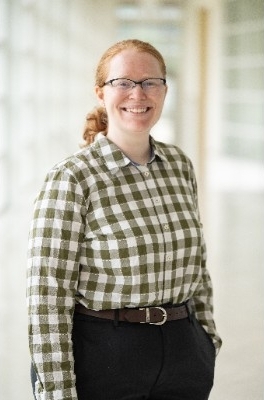
Dr. Diana Forbes, Assistant Professor of Physics and Astronomy at DePauw University, is passionate about physics education, clear scientific communication, and student success. She strives to make physics engaging, accessible, and intellectually empowering for students of all majors and backgrounds. Her courses blend structured lectures with active learning, collaborative problem-solving, and low-stakes assessments that build confidence alongside conceptual mastery. Forbes works intentionally to create a classroom environment where students feel comfortable asking questions, supported in their challenges, and encouraged to grow.
Forbes has prioritized meaningful student relationships throughout her teaching career, believing that trust and belonging are essential for learning. She is highly accessible through office hours and individualized support, and she mentors students in academic planning, research, and career development. She is especially committed to supporting students who may feel marginalized or intimidated in STEM, working to reduce barriers that have historically limited participation.
As a theoretical and computational particle physicist, Forbes provides extensive supplemental resources and emphasizes clarity over jargon, showing students how mathematical tools connect to physical meaning. Beyond the classroom, she serves as a faculty sponsor for student organizations and engages in community outreach. You can find her volunteering at the local observatory, having lunch with her students, or leading student hikes through the nature park. Her teaching fosters confidence, curiosity, and long-term engagement with science, helping students see both the big picture of physics and their place within it.
PhD Thesis at University of Illinois at Urbana, Champaign (May 2025):
I outlined my physics graduate research and provided additional background about the projects.
Paper: Doctoral_Thesis
Exotic Particles at the DUNE Near Detector from Charged Pion Scattering (Nov 2024):
We explored a previously overlooked channel for detecting millicharged particles via interactions with charged pions. By building a theoretical model and analyzing the expected signals, we found additional sensitivity for millicharged particle masses between 1.5 and 3 GeV.
Paper: MCP_Search
New Searches for Muonphilic Particles at Proton Beam Dump Spectrometers (June 2023):
Motivated by the muon g-2 discrepancy, I developed a model for a new particle that interacts with muons and designed a novel search strategy using Fermilab’s SpinQuest experiment, which is currently collecting data and expected to continue until around 2030.
Paper: Muonphilic_Scalar_Search
For questions/comments: dmforbes123 (at) gmail.com
Other Stuff! CV , Pedagogical Examples/Course Material, Service/Volunteering, Cooking, Fishing (?), Art, etc idk