On the first day of any introductory physics class, I like to hand out an initialassessment that I wrote. It's titled "Math Readiness Assessment", and it's intended to assess my students' math skills that they'll need in the class. I began doing this because I noticed a concerning lack of basic math skills at liberal arts schools- many of my students struggle with basic algebra and a handful of students have trouble subtracting fractions!
I get their math assessments graded before the next class, and I give them a score between 1 and 5. When they come to class the next day, I discuss my feedback at the beginning of the lecture. A score of 5 means “You are a math wizard and I am impressed!” and a score of 1 means "I am very concerned about your math skills, and you'll have to work hard to do well in this class." In my most recent section, I gave out two scores of 1, and both students took the initiative to meet with me after class to discuss how to catch up. I've been able to provide them online resources, which they've been going through. I have not re-assessed them, but I know who to keep my eyes on as the semester progresses. I'm proud that I've been able to design this assessment and feedback system, as I can already tell that students benefit from additional communication and support.
In addition to the Day 1 "Math Readiness Assessment", I also give them aStudent Questionaire to fill out: . This document is helpful for getting names and pronouns straight, along with hearing more about things like their expectations for me, disabilites they may have that haven't been reported, and their outlook on the course. It also gives me ideas of what types of learners they are, what class activities they'd like, etc. This is very helpful feedback from the first day, as I'm able to structure my lectures and class time in ways that feel aligned with the benefit of the majority of students.
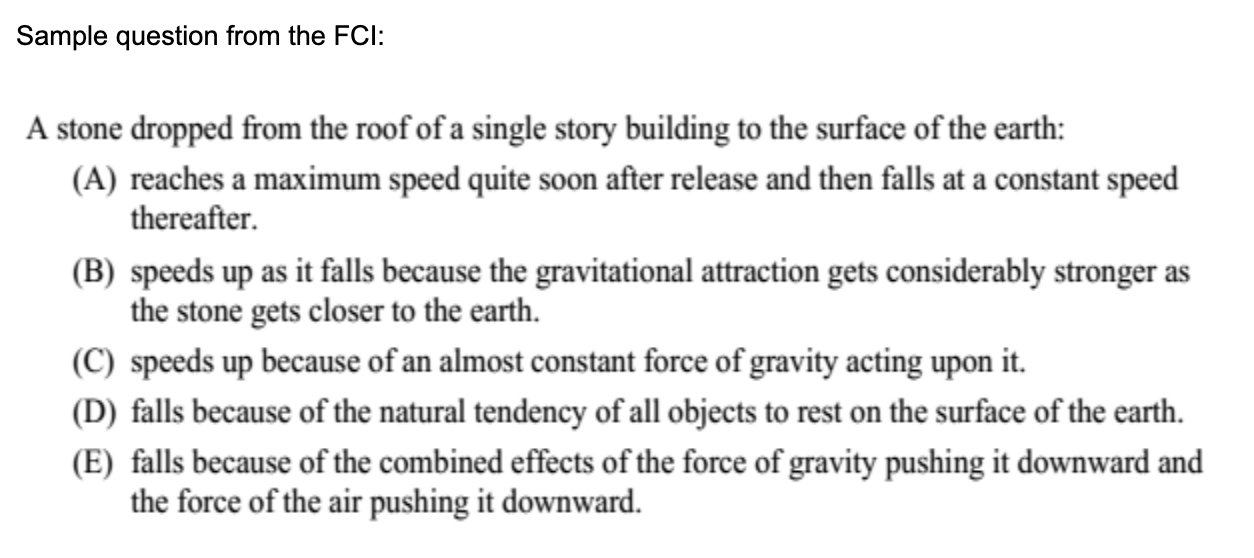
One more thing I do in the first few days of class is I have my students take an assessment called the Force Concept Inventory (FCI). This inventory was developed in 1992 by physicists David Hestenes, Wells, and Swackhamer. It's a 30 minute exam with 30 multiple choice questions like the sample below. They don't need a calculator for this exam, and it tests them over things including but not limited to reading graphs, understanding the difference between position, velocity, and acceleration, and understanding applications of Newton's Second Law.
I'm transparent with my students before handing it out to let them know what the assessment is, what their results mean, and what my expectations are. I make it clear on day 1 that even if they get everything wrong, it's ok, and their grade is coming from participation. I also let them know that they'll be re-assessed on the last day to get a measure of how much they learned in the class! I compare their score at the beginning of the semester to their score at the end of the semester, and evaluate some statistics based on the concept of "normalized gain", described in Thomas Moore's "Six Ideas That Shaped Physics" page 7:
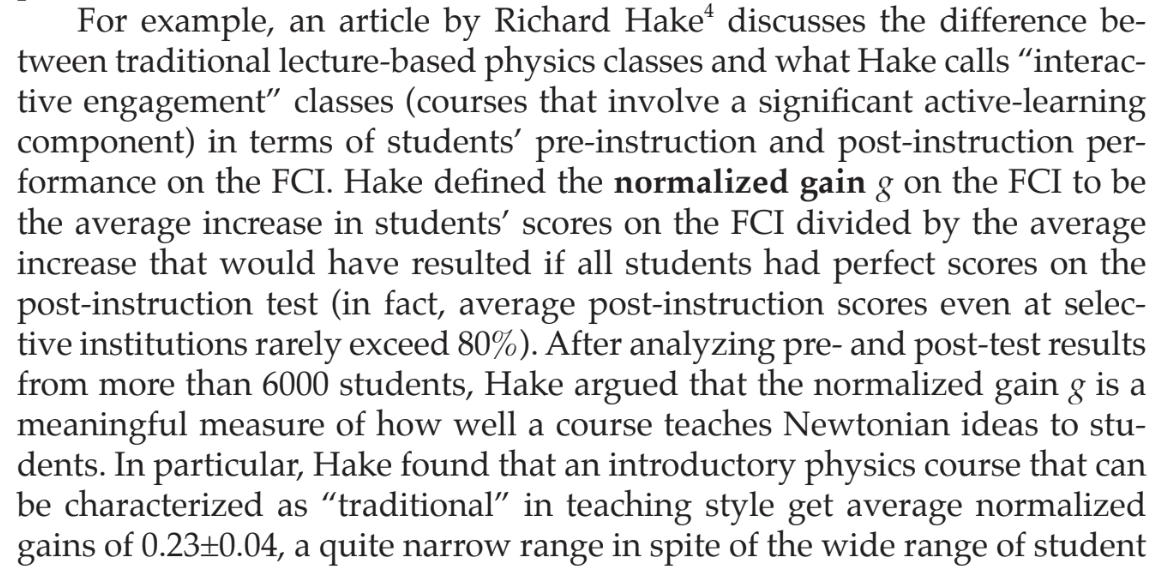
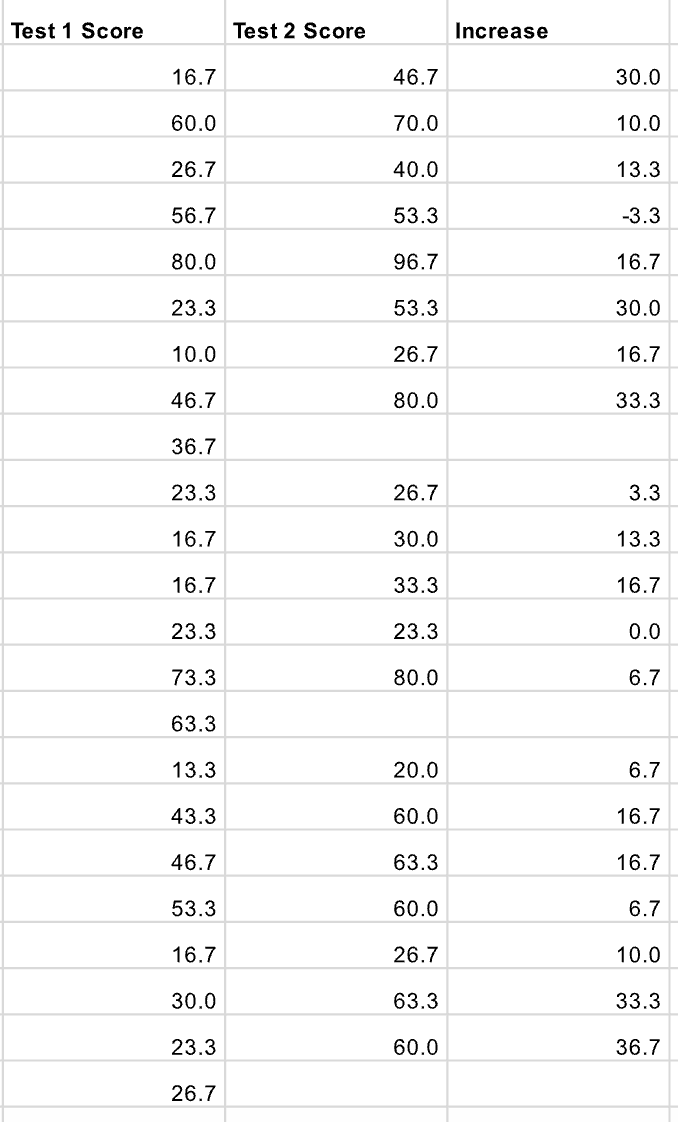
The student results at DePauw have seemed a bit lower than I would hope for. In the Fall of 2025, my 50 students in PHYS 120 had an average normalized gain g around 0.254. Moore writes that for a classical lecture setting, we should expect g ~ 0.23, and a value of g ~ 0.48 for a classroom environment that incorportaes active learning. In 2002 and 2003, DePauw was seeing a value around g ~ 0.59. I have not had the chance to compare my students' normalized gain to other instructor results at the University. I do suspect there is strong evidence that student retention has been delclining since 2020 through modern day due to the effects of the Covid-19 Pandemic, smart phone usage in the classroom, and the rapid increase in reliance on AI usage. One issue that physics faculty at DePauw face with this inventory is very small sample sizes. Being a liberal arts college, there are only about 24 students per section of intro physics, and there are only 1 or 2 sections taught per semester. Hence, it's hard to get clear statistics on student retention.
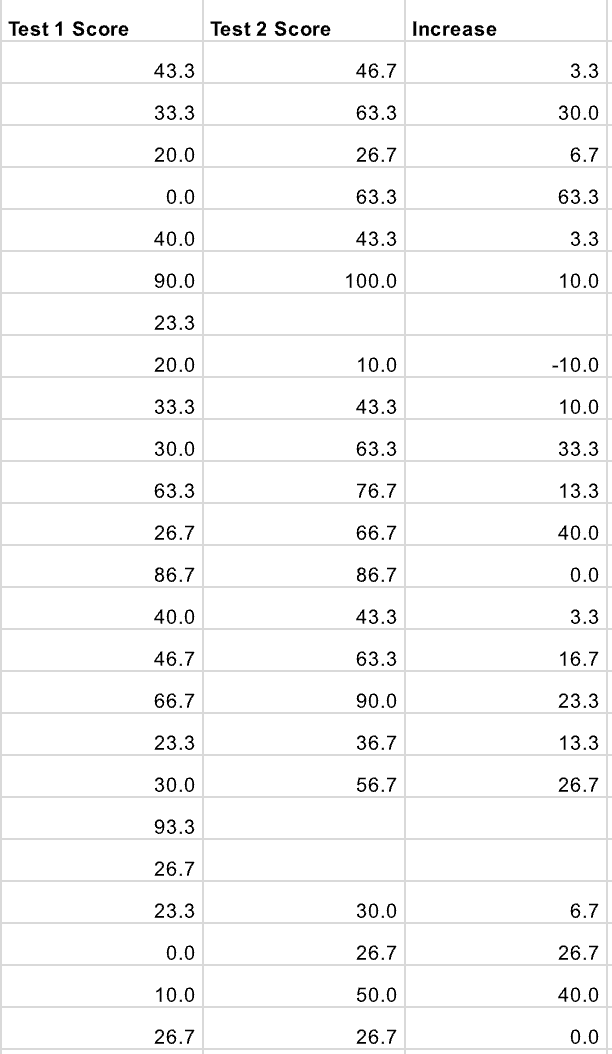
Below, I share the data I collected from the Fall 2025 semester. We see that some students were absent on the day of assessment, and a handful of students strangely performed worse or the same on the second day of the assessment. Looking through the data, I can confirm that the majority of the students on the lower end of the % increase value were students who tended to skip class...
DePauw, Fall 2025 FCI Student Results
I'm hoping to publish here a follow-up to report the results of my Spring 2026 PHYS 120 students once I can check the statistics. However, my sample size will be cut in half. But maybe I can see an improvement which would be a fun testament to my growing as an insturctor between the semesters.
I also wanted to show off my typical classsyllabus . You'll find hyperlinked an example of the classroom policies I set with my intro students. I got the overall template from my boss, Dr. Alexander Komives, at DePauw, but I edited the wording to align more with my personal teaching philosophy. I also added sections on cell phone usage policy, and extended the A.I. usage policy in my course syllabus.
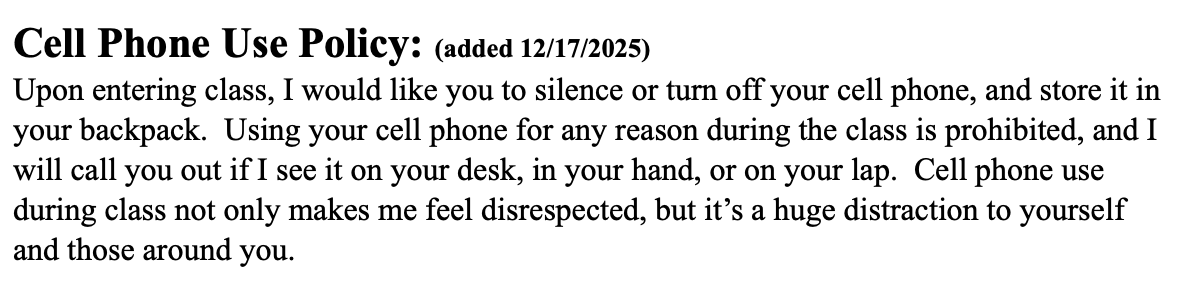
During my first semester of teaching here at DePauw, I found that smart phone usgae during lectures was rampant and progressively got worse through the semester. Students increasingly distracted each other and disengaged from participating, and I've decided to take a stricter approach with them. I now enforce the policy described in the screenshot below. Classes have gone much better sincebecoming stricter and more assertive, which is a huge way I've grown since starting my career here at DePauw.